

“Without the idea of texts that can be picked up at different times and in different places by otherwise unrelated people, we would not imagine a public as an entity that embraces all the users of that text, whoever they might be. Often the texts themselves are not even recognized as texts –– as, for example,
with visual advertising or the chattering of a DJ –– but the publics they bring into being are still discursive in the same way.” (Warner, Publics & Counterpublics, 2021)
This quote can mean very different things to many people, but that is the point of the quote. When we focus on the author’s meaning of “unrecognizable texts” it can be applied to anything that speaks to a person, or that has the same impact on them as writing would. In Naming What We Know, the authors, differently, brush on how writing provokes us to think. It helps us to sort our thoughts, as well as, it impacts our writers by provoking a thought process for them as well, on the discussed topic. When anything else that is introduced to us, like “visual advertising or the chattering of a DJ,” as Warner provided, then it is considered a text, in itself because it has the same effect that reading an article would. After all, writing is only one way of expression.
In my world, another example of “unrecognizable texts” would be political cartoons. Some have few words, and others don’t have words at all. Regardless, they were enough for a PQI section in an AP exam, and that is enough to show viewers that a picture truly says a thousand words. Specifically, in our current time, our society is dealing with very different struggles revolving around politics. Therefore, the cartoons are very different. With all due respect to others’ beliefs, the example I have provided spoke very loudly to me because it is very clear how the author felt. Also based on the date of publication, the author felt it strongly because it was drawn and published the same day that Pete Hegseth released his speech to the Department of Defense. Considering the chatter around this image, it was clear that people felt plenty of disrespect from Hegseth due to the way he was speaking to higher rankings in the U.S. Army. Nevertheless, without that prior surrounding knowledge, viewers still receive the same message. By drawing Hegseth as really small in comparison to the boots of those who were in his audience, it is clear to see that the author is communicating that the guidance and changes he spoke of, in his speech, were coming from someone deemed unqualified. Furthermore, the author includes the quote from Hegseth implying that he wants to inform those giants about the “Warrior Ethos.” For context, the Warrior Ethos is: “I will always place the mission first, I will never accept defeat. I will never quit, and I will never leave a fallen comrade.” It is a portion of the Soldier’s creed, and it is crucial to be memorized by service members. Knowing this, it only makes the picture stronger. Although the picture leaves room for viewers’ personal interpretation, the initial and direct message is very clear. For viewers who aren’t familiar with the speech or with Hegseth’s own army career, they would still understand the message. I chose this as my example of unknown texts because of how personal it is to me. When I first saw this picture, I felt like all my thoughts and feelings were captured. It was perfect because I had too much pain to form words. Considering that I had seen the cartoon before listening to the speech, and it still impacted me enough to start a conversation about it, then it lit up my brain in the same areas that a beautiful piece of literature would.
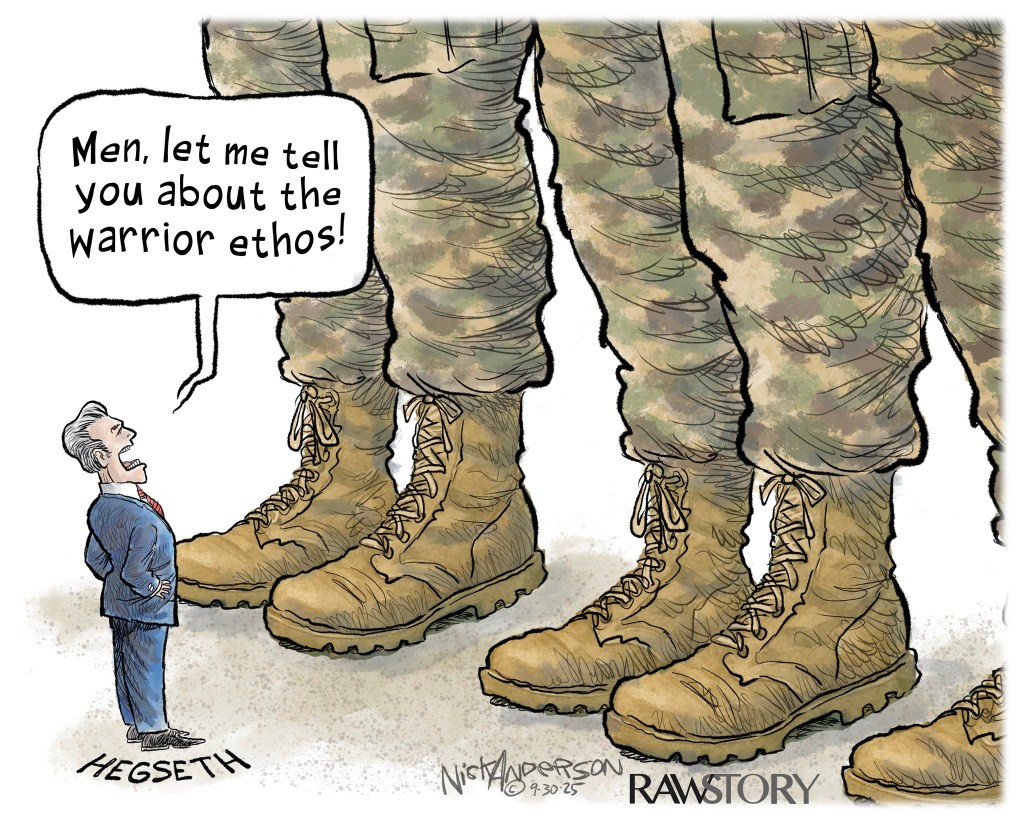
Source: RAWSTORY Publications via Facebook; Artist: Nick Anderson
 Site Title
Leave a comment